
Fine jaw crusher is an efficient equipment for medium and fine crushing of small and medium-sized ores or construction aggregates. Its parameter design and application scenarios directly affect the efficiency of the production line and the quality of the finished product. The following analysis is carried out from two aspects: core parameters and typical applications.
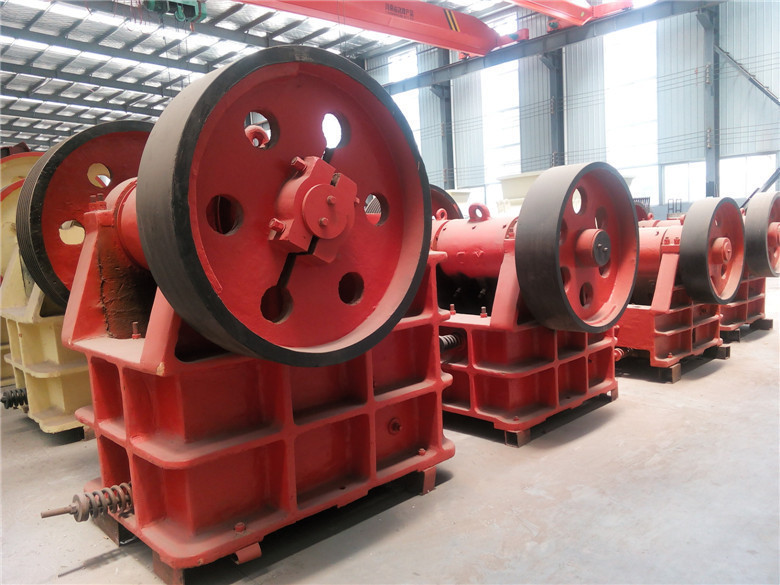
1. Fine jaw crusher Analysis of core parameters
Feed port size and processing capacity
The feed port width of the fine jaw crusher is usually between 150-500mm, the depth is 300-800mm, and it can process block materials with a side length of ≤300mm. The processing capacity varies depending on the model, with an output range of 5-300 tons per hour. For example, the feed port size of the PEX-250×750 model is 250×750mm, the maximum feed particle size is 210mm, and the processing capacity is 15-50 tons/hour.
Motor power and energy consumption
The motor power range of the equipment is relatively wide. Small machines (such as PEX-150×750) are equipped with 15-30kW motors, and large machines (such as PEX-300×1300) need to be equipped with 55-110kW motors. The overall energy consumption is 20%-30% lower than that of traditional jaw crushers, which meets the needs of energy-saving production.
Discharge port adjustment and finished product particle size
The discharge port width is adjusted by hydraulic or mechanical devices (range 10-100mm), and the finished product particle size can be controlled between 10-60mm. Some models can achieve a fine crushing effect of ≤5mm by optimizing the movable jaw trajectory, meeting the high standard requirements of sand and gravel aggregates.
Structural design and wear resistance
The movable jaw plate and fixed jaw plate are cast with high manganese steel, and the replacement cycle is extended to 6-12 months with modular design. The movable jaw stroke (eccentricity of the eccentric shaft) is 10-35mm, taking into account both crushing efficiency and equipment stability.
2. Fine jaw crusher Typical application scenarios
Mine medium and fine crushing
In metal mines such as iron ore and gold mines, fine jaw crusher is often used as secondary crushing equipment to further crush the coarsely crushed ore (particle size ≤300mm) to 10-30mm, providing uniform raw materials for subsequent ball milling process.
Building aggregate production
It is used for crushing hard rocks such as granite and basalt. By adjusting the discharge port parameters, it can produce aggregates of various specifications such as 5-20mm and 10-30mm to meet the needs of concrete mixing plants and road construction.
Solid waste resource treatment
In the field of construction waste recycling, fine jaw crusher can crush concrete blocks, bricks and tiles and other materials. With the iron remover and screening system, the aggregate recycling rate can reach more than 80%.
Mobile crushing station core unit
Integrated in tire or crawler mobile crushing station, it can flexibly adapt to temporary operations in quarries or urban demolition projects. A single machine can complete the "crushing-screening" process and reduce transportation costs.
3. Fine jaw crusher Summary of technical advantages
The fine jaw crusher has become the preferred equipment for small and medium-sized crushing lines due to its compact structure, low failure rate and precise particle size control. Its parameter design takes into account both high efficiency and economy, and is irreplaceable in the fields of mining, building materials, environmental protection, etc. In the future, with the application of intelligent control technology, the fine jaw crusher will further improve the level of automation and provide better solutions for industrial crushing.