

Analysis of Suitable Applications for Electromagnetic Vibrating Feeders
1. Material Characteristics Determine Selection
Powdered or Small Particle Materials
Electromagnetic vibrating feeders use high-frequency vibrations (700-3000 vibrations/minute) to achieve micro-throwing motion. They are suitable for conveying loose materials with a particle size of ≤150mm, such as lightweight powders like flour and talc. Their feeding accuracy can reach ±2%.
Compared to electric vibrating feeders, electromagnetic models are less adaptable to sticky materials, but their enclosed design reduces dust emission.
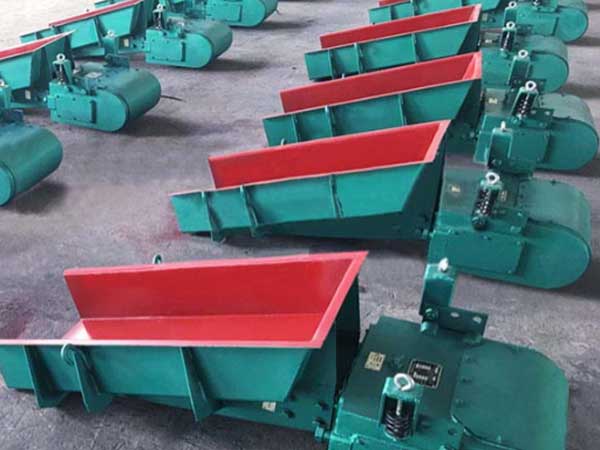
High-Temperature or Corrosive Environments
Electromagnetic feeders with alloy steel troughs can withstand temperatures up to 200°C and chemical corrosion, making them suitable for conveying slag or acidic and alkaline materials in the metallurgical and chemical industries.
2. Matching Production Requirements
Precise Quantitative Control
The half-wave rectifier electrical system supports stepless flow rate adjustment (5-100 tons/hour), making it suitable for applications requiring stable feeding, such as automated batching and packaging lines. For example, in ceramsite production, electromagnetic feeders can precisely control the ratio of clay and additives, with an error rate of less than 3%.
Space-Constrained Scenarios
The device's small size (for example, the GZ5 model weighs only 200 kg) makes it suitable for installation in confined production lines or beneath silos where vertical feeding is required.