
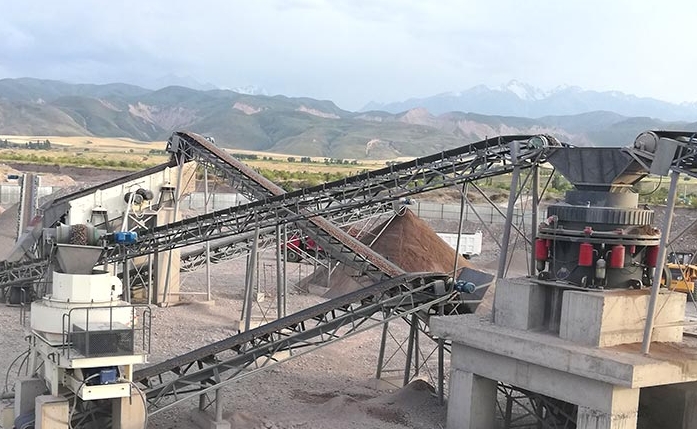
River pebbles are typical hard rock raw materials in machine-made sand production due to their high hardness (above Mohs 7) and compressive strength (≥300MPa). For large-scale crushing needs of 1000 tons/hour (1000tph), it is necessary to comprehensively design equipment configuration solutions from four dimensions: coarse crushing, medium crushing, fine crushing and auxiliary systems, taking into account efficiency, cost and environmental protection requirements.
1. Coarse crushing: jaw crusher as the core
As primary crushing equipment, jaw crushers are the first choice due to their high compressive resistance (can handle raw materials with a diameter of ≤1200mm) and stability. For a production capacity of 1000tph, it is recommended to use the CJ series European version jaw crusher (such as CJ160 or CJ200). Its hydraulic adjustment system can quickly adjust the size of the discharge port to adapt to the high hardness characteristics of river pebbles, and the processing capacity of a single machine can reach 1200-2000t/h12. Compared with traditional jaw crushers, the European version adopts a modular design, and the life of the wear-resistant liner is increased by more than 30%.
2. Secondary and fine crushing: Cone crusher and roller crusher synergy
Secondary crushing stage: It is recommended to use a single-cylinder hydraulic cone crusher (such as SC560 or HXHP800). Its lamination crushing principle can reduce steel consumption and process materials with a particle size of ≤560mm. The output of a single machine reaches 500-1000t/h. The hydraulic cavity cleaning system can quickly discharge stuck materials to ensure continuous operation. Fine crushing stage: Roller crushers are the best choice for fine crushing due to their low over-crushing rate (finished product particle size 2-10mm) and energy-saving advantages (energy consumption reduced by 15%-20%). Equipment equipped with wear-resistant alloy rollers (hardness ≥HRC60) can extend the maintenance cycle and achieve precise particle size control with the hydraulic adjustment system.
3. Screening and washing: multi-stage linkage to improve quality and efficiency
Vibrating screen system: 3YK3675 multi-layer heavy-duty vibrating screen is used, with a screening efficiency of ≥90%, to achieve classification of coarse aggregate (>10mm), medium aggregate (5-10mm) and fine sand (≤5mm). The closed-loop design can return oversized materials to the cone crusher for reprocessing, improving resource utilization. Sand washing process: XS4500 bucket sand washer is configured to remove stone powder and impurities through high-pressure water flow, so that the mud content of machine-made sand is ≤1%, which meets the standards for construction sand.
Typical configuration scheme and cost analysis
| Equipment type | Recommended Models | quantity | Total power (kW) |
| Jaw crusher | CJ200 | 1 unit | 400 |
| Cone crusher | HXHP800 | 2 units | 750×2 |
| Roller crusher | 2PG2000×1200 | 2 units | 560×2 |
| Vibrating screen | 3YK3675 | 3 units | 45×3 |
| Sand washer | XS4500 | 2 units | 30×2 |
Conclusion
The 1000tph river pebble crushing line needs to be based on "jaw crusher + cone crusher + roller crusher" as the core, combined with intelligent and environmental protection technology to achieve efficient crushing and green production. Equipment selection should give priority to wear resistance, degree of automation and energy consumption indicators, and improve the qualified rate of finished sand to more than 95% through multi-stage screening and closed-circuit circulation.