
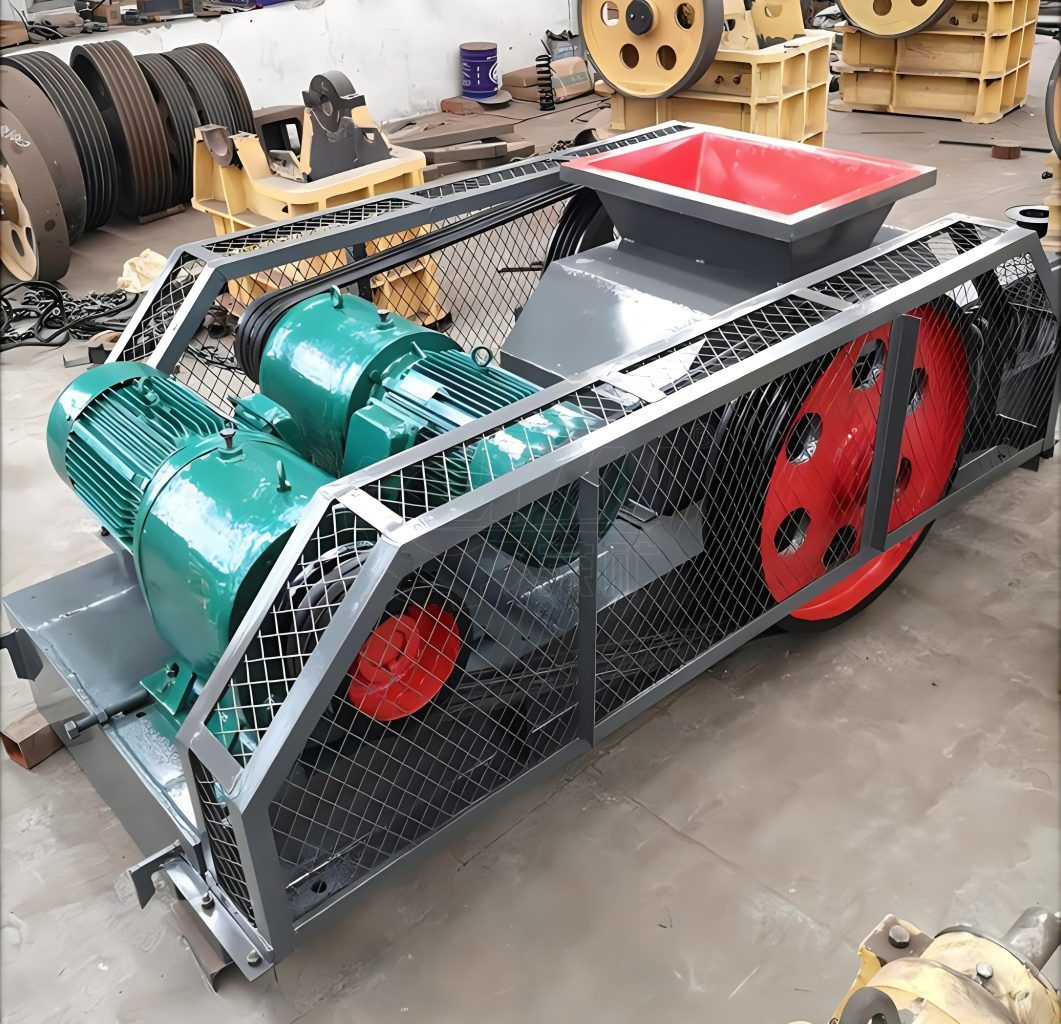
As a key equipment in the mining and building materials industries, the strength and rigidity of the frame of the double-roll crusher are directly related to the service life and operational safety of the equipment. To ensure the stability of the frame structure, it is necessary to implement full-process control from design selection to daily maintenance, which can be systematically strengthened through the following seven dimensions:
1. Optimized materials
Use high-strength low-alloy steel (such as Q345B) or cast steel parts, taking into account both strength and plastic deformation capacity, ensuring that the material yield strength is ≥345MPa and the elongation is ≥20%.
2. Frame reinforcement
Use finite element analysis to optimize the box structure, add radial reinforcement ribs in stress concentration areas such as bearing seats, increase the thickness of the side plates to 16-20mm, and reduce the stress concentration factor to below 1.5.

3. Precision welding
Key welds use double-sided groove welding, anneal at 650℃ after welding to eliminate stress, and the ultrasonic flaw detection rate is 100%, ensuring that the weld strength is not less than 90% of the parent material.
4. Dynamic monitoring
Establish a three-level detection mechanism: daily visual inspection, monthly feeler gauge measurement of joint surface gap, annual magnetic particle flaw detection, and focus on monitoring high-risk areas such as reducer base.
5. Intelligent control
Equipped with torque sensor and PLC linkage system, the speed will be automatically reduced when the load exceeds the limit by 15%, and the impact load will be reduced by more than 40% with the hydraulic buffer device.
6. Pre-tightening and reinforcement
For high-hardness material working conditions, a 25mm removable manganese steel guard plate is installed; the output improvement equipment can be equipped with a Φ50mm prestressed pull rod to provide a 300kN pre-tightening force.
7. Periodic maintenance
Tighten the anchor bolts to the standard torque every 500 hours, perform laser leveling correction every 2000 hours, and adjust immediately if the flatness deviation is greater than 0.5mm/m.
Through the above measures, the deformation of the frame can be controlled within 0.15mm/m, the structural natural frequency can avoid the 8-12Hz working frequency band, and stable operation without major repairs can be achieved for 3 years. It is recommended to regularly perform three-dimensional scanning to establish a digital twin model and form a full life cycle strength management system.